By Eduardo Magaña
I no longer write the way I used to. I’ve been wondering why.
A year ago, when I was working as a reporter in southern Alabama, writing was something my job demanded almost every day. It was not just the act of putting words on a page. It was a routine that required going out and hunting for stories, knocking on doors, standing on football sidelines beneath stadium lights, sitting at kitchen tables with people whose lives unfolded quietly between pine forests and rivers.
Beyond the daily reporting, I wrote the occasional weekend column, small reflections about the rhythm of life in that corner of the American South.
And how could I not write?
My weeks were filled with endless local sports games, early-morning hunting trips, rodeos, and small-town parades where American culture revealed itself in its most theatrical form. There were the quieter stories, too: the lives of people who carried on their routines beneath the dense forests of the South, near the riverbanks and among the low, rolling hills.
Soon it will be a year since the last time I drove those roads.
The last time I drove out of Clarke County, the road was almost empty. Pine trees pressed close to both sides of the highway, and the sky had that deep orange color that only appears in the South at the end of summer. I remember lowering the window and letting the wind run through my fingers, as if the air itself were trying to hold me there a little longer.
Then I stopped at a Dairy Queen, bought an Blizzard, and ate it in my car while the evening news murmured through the radio.
Life there felt simple. Scenic, even.
As if you were living inside a loop you didn’t want to escape. And the truth is, I didn’t.
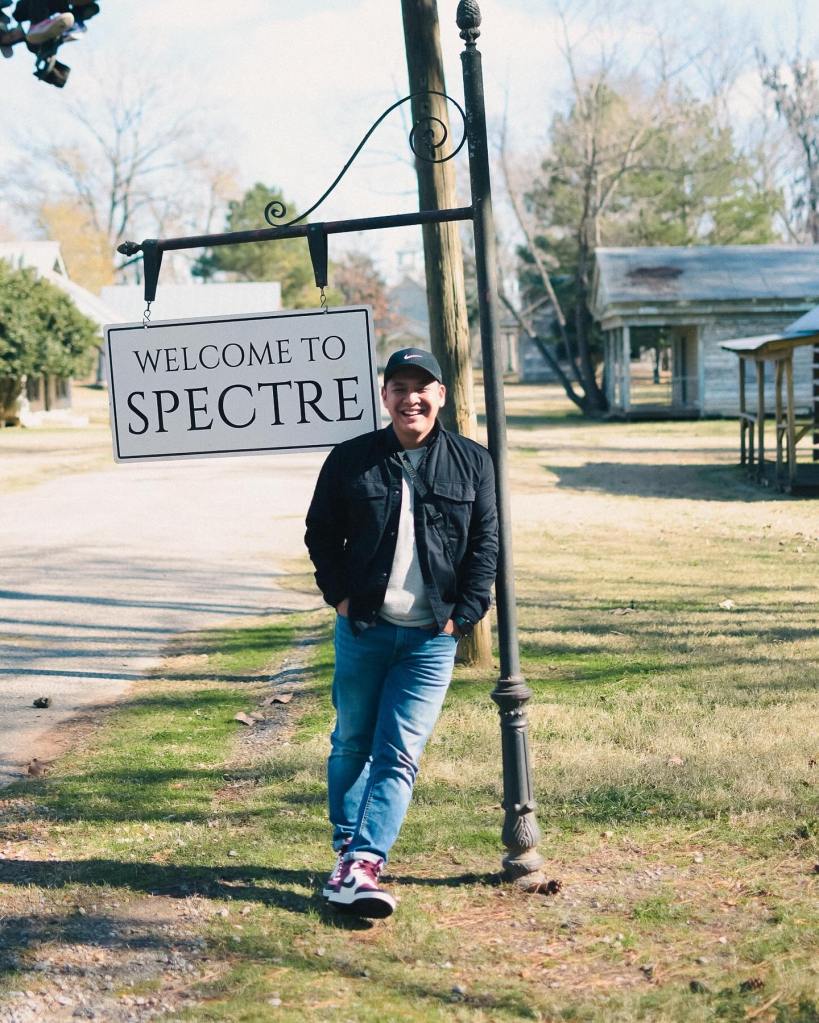
Sometimes, when I think about that life from afar, I imagine it the way the protagonist of one of my favorite films once experienced his own: when Edward Bloom enters the town of Spectre for the first time in Big Fish.
There are two small coincidences in that comparison. My name is Eduardo, like Edward. And the fictional town of Spectre sits in Alabama, near Montgomery, not terribly far from where I lived in Clarke County.
In the film, Edward discovers the town hidden deep in the woods. Life there unfolds slowly and simply. The townspeople follow gentle routines, and at night the place glows with soft lights as neighbors gather for small dances. Edward soon reveals his talents and becomes an essential part of the community.
But eventually the story darkens slightly.
Edward realizes that he must leave. That as comforting as small places can be, he was made for larger stages. There are more adventures ahead of him, and perhaps somewhere out there waits for the love of his life.
So, amid laughter, tears, and the disappointment of friends who hoped he would stay, Edward gathers his few belongings and walks away.
The first time I saw that film I was thirteen, maybe fourteen.
I remember being astonished by Edward’s life, so full of adventure, of strange characters who seemed to belong to circuses and fairy tales, of impossible landscapes and improbable feats.
After watching it a few times, a quiet obsession formed inside me: one day, I wanted a life like that. I wanted to see the world. To take risks. To live at the edge of things. To meet an endless number of faces. To fall in love with the most beautiful woman in the world and bring her flowers every chance I had.
Sometime after that, I drew a picture.
In it, I had sketched Spectre, the long wooden walkway Edward crosses when he first enters the town. I don’t think I fully understood what I had drawn, and I certainly didn’t know the place existed beyond the film.
But nothing can take a dream away from a teenager who has just seen himself reflected inside a story.
I was thirty when I discovered that Spectre was real.
Or at least, the film set where it had been built still existed. It sits inside a park in Montgomery, on Jackson Lake Island. Visitors pass through from time to time, though the island’s most loyal inhabitants are the goats that wander freely across it, friendly goats, as it turns out, who graze lazily between the abandoned houses of the set.
The first time I walked down that wooden path, I felt as though I had stepped inside the movie.
And I thought about everything that had brought me there.
Sixteen years earlier, I had drawn that same walkway while sitting in my parents’ restaurant. Now the place itself stood before me.
Like Edward, my life, by the age of thirty-two, has been filled with adventures.
Without realizing it, and without remembering the promise I once made to myself, I ended up living the life I had imagined as a teenager. I have seen so many faces that I can no longer remember half of them. What I do remember is the feeling each encounter left behind, the love, the wonder, the sadness, the small flashes of joy.
There was an old man who used to sit every morning at the same table in a diner in Grove Hill.
He drank black coffee and read the newspaper with the careful patience of someone who had done it the same way for forty years.
One morning he asked me where I was from.
“Mexico City”, I said.
He looked up from the paper and nodded slowly.
“That’s a long way to come just to watch high school football.”
That was true, after all. Leaving Alabama may have been the hardest, and perhaps the best, decision I have ever made.
How do you leave a place that seems to have everything?
But the truth is, it had almost everything.
What it didn’t have was the next chapter.
Life doesn’t end at thirty-one. I wasn’t ready to retire into the comfort of landscapes, familiar faces, dances, and dinners.
If things go well, I may have several lives ahead of me.
And abandoning the dreams of my younger self is something I simply cannot do.
It took me a year to realize that something exists beyond my own version of Spectre. That leaving it behind does not mean denying it ever existed. That continuing to explore, to reinvent myself, might be the best way to honor everything I loved while I was there.
Which brings me back to the original question.
Why did I stop writing the way I used to?
The answer may lie in the quiet grief I carried with me when I left. A feeling that perhaps I could only be that person, the writer I was, inside that place.
Now I live in Mexico City, a place I have often called home, though for years I also searched for ways to escape it.
How do you find inspiration in an ocean this vast?
How do you look in every direction and not feel like you’re drowning?
Perhaps that is exactly what I must do, let the city swallow me and reshape me. Rediscover adventure in its endless neighborhoods. Let its characters become the source of new stories.
I’m writing this at the edge of a desk in a new office job.
I’m not sure whether that means the system has finally defeated me, or whether I should treat this moment as the beginning of a new challenge.
Or perhaps the answer lies somewhere else.
Outside my window the city doesn’t rest. Cars move slowly down the avenue, their headlights sliding across the ceiling like restless thoughts. On my desk there is a notebook I haven’t filled yet.
Maybe the next story begins there.
Maybe the next adventure isn’t about escaping this city again. Maybe it’s about building something from everything I’ve already lived.
Writing. Leaving memory behind before words fade into echoes carried by the wind.
Leaving a testimony in ink of what this life was before I turned thirty-two.
Growing.
Letting go.
Allowing myself to rest.
And allowing the words to return, so that others may travel through them the way my restless mind still does every single day.
 Eduardo Magaña
Leave a comment