Arely Pérez, better known on the field as Coach Kelly, isn’t your typical figure in Mexican football. Her story goes beyond tactical schemes and game-day strategy; it’s a testament to resilience, leadership, and the audacity to shatter barriers in a space still largely ruled by men.
As coach of the Borregos CEM team in ONEFA’s top division, and a vocal advocate for women in sport, her role is not only to develop performance on the field but to rewrite the narrative of what leadership, and womanhood, can look like in football.
When speaking of her career, Kelly highlights a skill that might not immediately come to mind when thinking of football: engineering.
With a background in biotechnology, she brings a singular perspective to training sessions.
“It’s something I lean into a lot, being able to integrate all the skills I developed through my academic and professional path,” she says. “Engineering thinking, quantitative evaluation, statistical clarity, and process improvement, these tools haven’t just helped me be more precise, they’ve made me more meticulous. Every detail in training becomes a part of the broader system, the long-term goal.”
For Kelly, each practice is a process of continuous optimization, just like in the lab. The key difference, of course, is that here she’s not working with molecules, but with people, living, breathing athletes who carry emotional weight, personal battles, and dreams of their own. That’s where her coaching becomes something more: a fusion of science and humanity, of discipline and empathy.
At the heart of her coaching philosophy lies the cultivation of leadership, a non-negotiable, in her view, for any successful team.

“Honesty is the cornerstone of our culture at Borregos CEM,” she says. “It starts with acknowledging our mistakes, learning from them, and growing. But more than that, it’s recognizing that every action, on or off the field, has consequences. Responsibility is the first step to becoming a leader.”
In Kelly’s framework, players are expected to excel not just athletically, but academically and personally. Leadership, for her, is not confined to the locker room, it’s a holistic discipline.
Her approach is further enriched by experiences far beyond the gridiron.
“I love to travel, to learn from different cultures,” she says. “I’ve visited several countries in Europe and watched how they train for individual sports, how they structure it. It opens your mind, you get out of the tunnel vision of just football. I’m also deeply passionate about Mayan culture. It’s something I’ve studied. It reminds me to honor our roots and history, and that’s something I try to pass on to my players.”
That reverence, for history, for context, for the unique path each player walks, threads through her entire coaching ethos.
But in a sport where women have long been sidelined or rendered invisible, Coach Kelly’s journey has not been without obstacles. As the only woman coaching in ONEFA’s top division, she knows what it means to be an outsider.
“Being a woman in this sport is the biggest challenge, but also the greatest privilege,” she reflects. “When I started, there wasn’t even a position like this for a woman. I didn’t just have to prove myself as a coach, I had to prove that women deserve to be here, to lead, to influence. The barriers weren’t always visible, but they were real. Locker rooms built for men, uniforms designed only for male bodies. Small things, but they make you feel like you don’t belong.”
And yet, she carved a path where none existed. Today, she doesn’t just hold a coaching position in the highest league of Mexican college football, she’s spearheading a cultural shift.
That visibility, she says, is her symbolic victory.
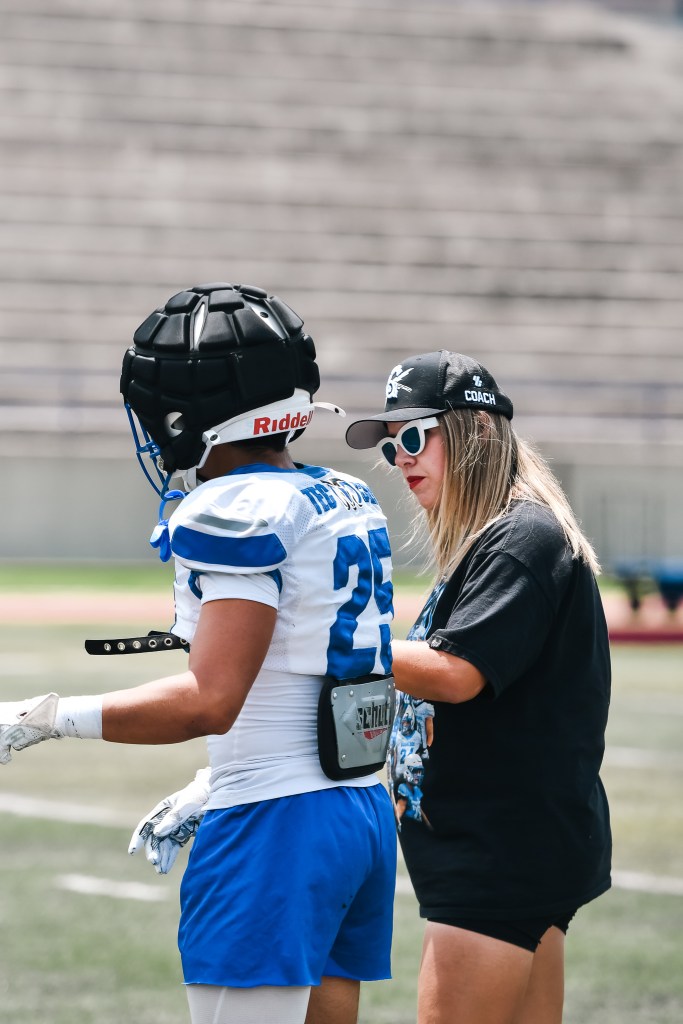
“It’s not just about me being here, it’s about there now being space for more women. What matters isn’t just stepping on the field, it’s being recognized as an integral part of the team, included in decision-making, in designing strategy,” she says.
Still, she’s clear-eyed about the road ahead.
“There’s so much left to do. Women need to be seen not just as players, but as coaches, as leaders. Visibility is key. It’s what will inspire more women to step up, not just to join the team, but to run it,” she says, with a conviction that leaves no room for doubt.
Her leadership has also catalyzed the formation of a growing network: Women Coach FB and Flag, a platform that brings together female coaches from across Latin America and Europe to share knowledge, support each other, and keep pushing the game forward.
“I’ve built a community of 30 women coaches, and my goal is to keep growing it, creating a space where we lift each other up, where our work is seen and respected. In sports, women often do the heavy lifting behind the scenes, but don’t get the spotlight. I want to change that,” she says, her voice thick with purpose.
Though flag football and traditional tackle football are often viewed as distinct worlds, Kelly sees them as deeply intertwined.
“Flag football is a variation of American football. The foundation is the same, but the gameplay shifts, it’s faster, the field is smaller, you need more agility. But if you train in tackle football, the tactical and physical skills translate naturally,” she explains. “For me, the main difference is in pace and space. But the principles? They’re the same.”
When asked how she builds team culture behind closed doors, in the everyday grind of the locker room, she doesn’t hesitate: honesty, attitude, aggression, and responsibility. Those are the pillars.
“These values don’t just apply on the field, they’re for life,” she says. “Our philosophy at Borregos CEM isn’t just about winning games. It’s about developing people who can face life with integrity and strength.”
Coach Kelly doesn’t speak in platitudes. She speaks in systems, in processes, in purpose. And like any well-built playbook, her blueprint for change is both methodical and visionary: teamwork, leadership, and an unshakeable respect for the path behind, and the one still ahead.
 Eduardo Magaña
Leave a comment