For as long as I can remember, I’ve been enchanted with the spectacle of wrestling, though “wrestling” feels too clinical a term for what I experienced.
“Gods,” “superheroes,” “immortals”, these are the names Mexican society ‘ve given them, and not without reason. Beneath the theater of body slams and rope dives is something ancient, ritualistic even. Mexican wrestling, or lucha libre is myth-making in real time, a morality play in tights and glitter, choreographed but sincere in its emotional stakes.
My earliest memories of this world are steeped in the ritual of Sunday mornings in La Prensa Nacional, a working-class neighborhood on the outskirts of Mexico City, where my paternal grandmother lived. She was a woman of great conviction, she believed in saints, in the power of ruda vs. técnica, and that chicharrón tacos should never be served without guacamole.
Each Sunday, after a stroll through the street market, she’d gather us around her old television set above the fridge, and together we’d watch men in masks defy gravity and, at times, belief. That kitchen became my first arena.
Back then, my hero was Octagón, a figure whose black and white mask suggested a kind of disciplined nobility. I owned his action figure, a prized possession that never strayed far from my reach. His image stood in contrast to the luchadores of the 1950s, El Santo, Blue Demon, and Rayo de Jalisco, who had ascended beyond the squared circle into the realm of Mexican cinema.
They weren’t just athletes; they were silver-screen legends, our very own superheroes. These men emerged at a time when the country, still bruised from the Revolution War, was eager for symbols of virtue and resilience. They offered both.
But before any of these legends took their first bump on the canvas, there was Salvador Lutteroth. A former revolutionary lieutenant with an eye for spectacle, Lutteroth founded what would become the Consejo Mundial de Lucha Libre (CMLL) in 1922. By September 1933, he had organized the first official wrestling event in Arena México, a hallowed venue now considered the “cathedral of lucha libre.” That night featured Cyclone McKay, an Irish import, and Yaqui Joe, billed as the sole Mexican world champion at the time. The seeds of a distinctly Mexican tradition were sown.
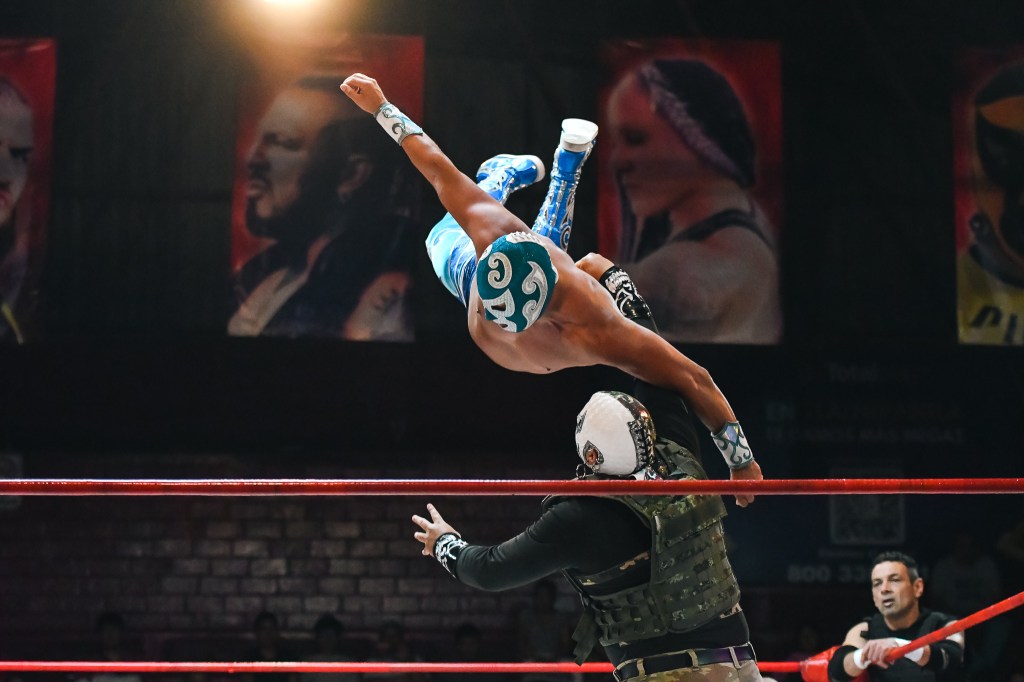
What unfolded from there was less a sport than a new form of national folklore. The Mexican wrestling style, full of aerial acrobatics, dramatic storytelling, and vibrant costumes, began to take root. It borrowed from American and European wrestling but quickly transcended them.
The dives over the ropes, the rhythm of bodies crashing on canvas, the deliberate contrast between técnicos (heroes) and rudos (villains), all of it was uniquely ours. And with it came the masks, which carry a spiritual weight here. To don a mask in lucha libre is to enter a lineage, to transform.
Of course, as with most childhood obsessions, my fervor waned. Teenage years brought with them other distractions. Wrestling, became a distant echo. Still, it lingered. I had a Booker T action figure. I watched WWE SmackDown when I could catch it on cable. But the heart-pounding awe of watching luchadores in my grandmother’s kitchen slowly became a nostalgic footnote.
Now, in my thirties, that awe has returned, albeit in a more deliberate, observational form. Perhaps it’s because lucha libre itself is undergoing a transformation. The acquisition of AAA, One of the largest Mexican wrestling promotions, by WWE sent ripples across the fandom.
So did the news that Penta 0 Miedo, one of Mexico’s most innovative performers, had joined WWE’s RAW roster. The cross-pollination between Mexican and American wrestling is no longer a one-way street; it’s a shared evolution.
With this rekindled curiosity, I recently set out to see lucha libre not just as a fan but as a witness, maybe even a documentarian. I chose Arena López Mateos in Tlalnepantla de Baz, a modest but storied venue in northern Mexico City.
Unlike the glitz of Arena México or the television production value of AAA broadcasts, López Mateos offers a more intimate, unfiltered and raw experience. For nearly 60 years, it has been a proving ground. Even Penta 0 Miedo had some of his most formative matches there.
Last Saturday night, I stepped into that arena.
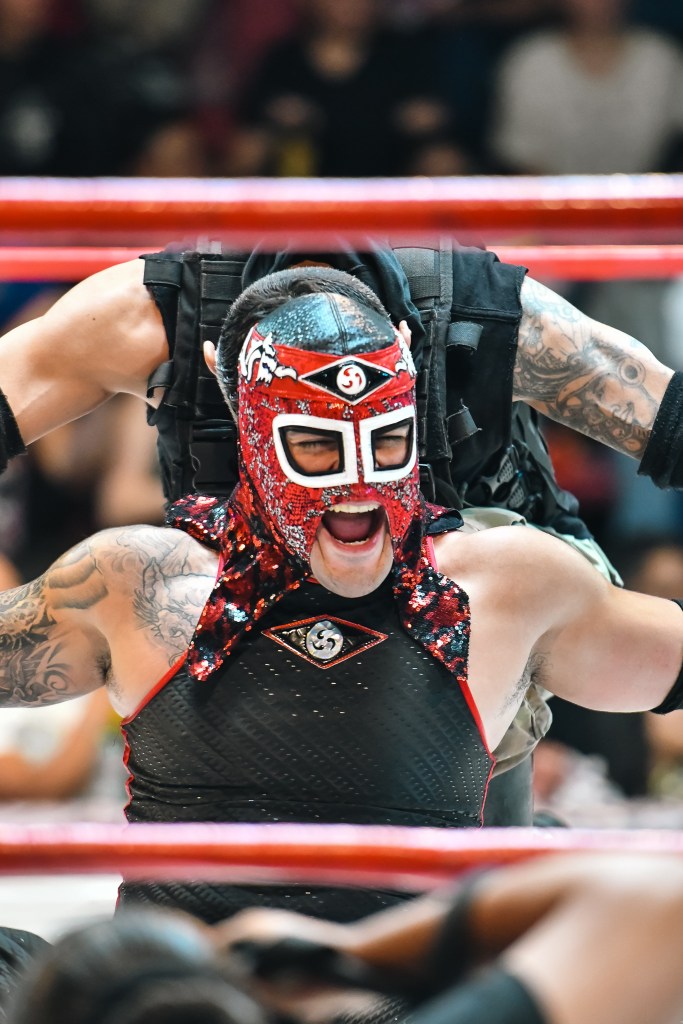
It was packed, pulsing with the energy of anticipation. Kids clutched popcorn and plastic masks. Fathers told stories of matches past. Vendors shouted over the din, selling micheladas and candy. The ring, centered beneath a halogen glow, felt both sacred and worn, like an altar with decades of prayers still echoing off the ropes.
The main event was a six-man tag match: Hijo de Octagón, Ciclón Ramírez Jr, and Huracán Ramírez Jr, each the heir to a wrestling lineage, versus Carta Brava Jr, Mocho Cota Jr, and Maniacop. These names, with their inherited suffixes and crafted personas, hint at something beautifully paradoxical about lucha libre: the constant reinvention of myth. Each generation inherits the mask but writes its own legend.
The match itself was a whirlwind. Hijo de Octagón, true to his legacy, led his team with athletic grace and uncanny precision. There were dives from the top rope, hard-hitting exchanges, and dramatic reversals. The audience, fully in character, hurled curses, and lived every near fall as if the fate of the nation depended on it.
For all its theatricality, nothing about the match felt fake. That’s the secret of lucha libre. Yes, the outcomes are predetermined. But the emotions, those wide-eyed kids, those proud parents, those performers hurling themselves with reckless passion, are real. The bruises are real. The legacy is real.
After the match, I lingered. I watched fans line up to take photos with Octagón Jr. I saw a little boy, maybe five or six, clutching his own Octagón action figure, waiting for an autograph. I couldn’t help but smile.
I thought of myself in that same pose, in that same wonder, two decades earlier in La Prensa Nacional. The kitchen. The tacos. The mask. I realized that this wasn’t just a nostalgic return, it was continuity. Lucha libre is less a story and more a song, passed down like a family ballad. It’s what we tell our children when they ask who the heroes were.
And so I left the arena with that sense, not of ending, but of something inherited. Mexican wrestling, at its best, is not a show. It’s a lineage. A masquerade of truth. A mirror in which we see ourselves braver, more resilient, more eternal.
 Eduardo Magaña
Leave a comment